
Are Back Seat Extenders Safe for Dogs? An Honest Guide
Share
Short answer: a hard-bottom back seat extender makes everyday drives safer and calmer for most medium and large dogs, because it closes the footwell gap they slip into on turns and stops. But it is not a crash restraint. No back seat extender we know of is crash-tested, ours included. The safe setup is an extender plus a harness clipped to a seat-belt tether, with your dog always in the back seat.
What a back seat extender actually does
A back seat extender is a seat cover with a rigid base. It spans the gap between the back seat and the back of the front seats, so the seat and footwell become one flat deck. For a big dog, that changes three things:
- No more footwell falls. On a bench seat, a large dog's back legs often slide into the footwell when you brake or turn. A hard bottom keeps them on a level surface.
- Room to lie down. Most big dogs won't settle on a narrow seat. Give them a flat deck about the size of a dog bed and many of them lie down and stay down, which is the calmest and most stable way for a dog to ride.
- Less scrambling. A dog that isn't fighting for footing is less likely to climb toward the front seats, which is the real distraction risk for the driver.
If you're comparing options, our back seat extender vs dog hammock guide explains why a soft hammock sags under a standing dog and a hard bottom doesn't.
What a back seat extender does not do
- It doesn't hold your dog in a crash. The straps hold the deck to the headrests. They don't hold your dog. In a hard stop or a collision, an unsecured dog can still be thrown forward.
- It isn't crash-tested. Be wary of any listing that implies an extender is a safety restraint. Crash-tested products exist (for example harnesses and crates certified by the Center for Pet Safety), but they're a different kind of product.
- It doesn't replace good habits. Dogs still shouldn't ride in the front seat, where an airbag can seriously injure them.
The safe setup, step by step
- Back seat only. Keep your dog behind the front seats, away from airbags.
- Install the extender firmly. Clip the straps around the rear and front headrests, tuck the seat anchors into the seat crease and slide the hard panels in. Push down on the middle: it should feel level and solid.
- Put your dog in a harness, never just a collar. A car tether on a collar can hurt your dog's neck if you brake hard.
- Clip the harness to a seat-belt tether. Loop the tether around a rear headrest (with an extender fitted, the seat-belt buckle can be hard to reach). Keep the lead short enough that your dog can sit, stand and lie down but can't reach the front seats.
- Two dogs, two tethers. Each dog gets its own harness and tether so they can't tangle.
- Check the fit for your vehicle. An extender that's too small leaves gaps at the edges. Too big and it bunches up. Measure across your back seat, door to door, before you buy. Crew cab truck owners can use our crew cab sizing guide.
Is an extender safer than letting a big dog ride on the seat?
For day-to-day driving, usually yes. The common problems with a big dog on a bare back seat are slipping into the footwell, standing and scrambling on every turn, and climbing forward. A flat, stable deck addresses all three, and pairing it with a tether covers the climbing. What an extender can't do is protect your dog in a serious crash. For that, look at a crash-tested harness or crate.
If your main problem is the footwell, our guide on how to stop your dog falling into the footwell walks through six fixes, from cheap to permanent.
What to look for in a safer back seat extender
- A truly hard bottom. Rigid panels, not just a stiff fabric layer, so it stays level when your dog stands on it. Ours uses removable hard panels rated to 400 lbs by the manufacturer.
- Four-point straps. Straps on both the rear and front headrests, plus seat anchors, so the deck can't slide on turns.
- The right size. Our hard-bottom back seat extender comes in L (52" wide) for cars, mid-size SUVs and small trucks, and XL (57.4" wide) for full-size crew cab pickups and full-size SUVs.
- A non-slip, waterproof cover. Better footing for your dog and easy clean-up for you.
- Honest labeling. A good brand tells you it isn't crash-tested and tells you to use a tether.
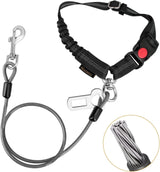
We sell a chew-proof steel tether that loops around the headrest and clips to your dog's harness. It isn't crash-tested either, but it keeps your dog in the back and on the deck.
FAQ
Are back seat extenders crash-tested?
We're not aware of any that are. Treat an extender as a comfort and footing upgrade, and use a harness and tether (or a crash-tested crate) for restraint.
Can a dog ride on a back seat extender without a seat belt?
They can, but we don't recommend it. Without a tether, nothing stops your dog from climbing forward or being thrown in a hard stop.
How much weight can a back seat extender hold?
It depends on the model. Ours has hard-bottom panels rated to 400 lbs by the manufacturer. Check the rating before you buy, especially for two big dogs.
Is a back seat extender safe for puppies?
Yes, with the same rules: a well-fitted harness, a short tether, and supervision. Puppies that chew may need a steel tether rather than fabric.
Do back seat extenders work with captain's chairs?
Sometimes. Most extenders are designed for a bench seat. With captain's chairs, the middle of the deck sits over the walkway, so measure the gap first or email us your vehicle and we'll tell you honestly whether it fits.
Not sure which size fits your vehicle? Email support@pawsomepups.co with your year, make and model and we'll confirm before you order.